|
|
| 20th November 2013 | Bluetongue | Home |
|
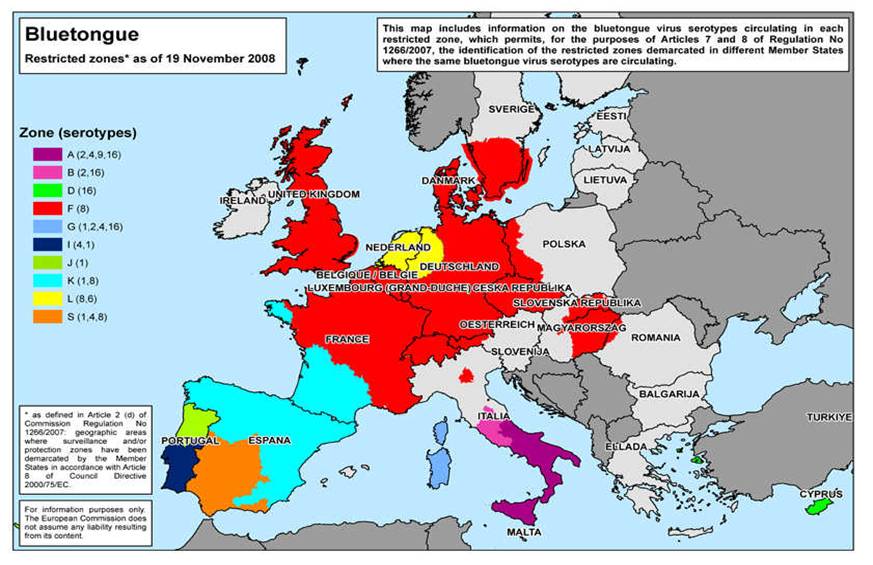
Bluetongue has become less of a problem in the past five years, but I will keep this page available if you wish to review the history of the disease in this country and I will update it if we should encounter further problems in the future. Bluetongue is a disease of farmed and wild ruminants that was first recognized in the 18th century in South Africa and has been seen throughout the tropical countries of the world. Since 1999 there have been sporadic outbreaks in southern Europe and it was not until the summer of 2006 that it appeared in Belgium, Germany and France. Until September 2007 the disease has never been seen in Britain. This is a virulent disease that can have a devastating impact on farmed livestock. It has a complicated live cycle involving different midge species, it appears in different strains that vary in their virulence and will only spread when temperature and climatic conditions are favorable. bluetongue has been much studied over the years, especially in the past three years, yet there is still a great deal that we have yet to learn about this virus. There are now 148 farms in the UK that have at one time or another been under Bluetongue restrictions either because animals caught the disease from infected midges in the autumn of 2007 or they imported animals from Europe in 2008. All but one of these farms have had to deal with the BT8 strain of the virus. On 25th November five imported cattle on a farm near Blackpool were found to be carrying BT1. These animals have now been slaughtered. It is not possible for me to explain why cattle and sheep can freely come into the country from France, Germany, Holland and Belgium without any paperwork to say that they have tested clear for the Bluetongue Virus. It is asking for trouble and that it what we have got. DEFRA report that there are 12 million doses of the Bluetongue Vaccine ordered that were not used in England in 2008. That is nearly half of the original order that was secured in December 2007.This is disappointing as many animals in England and Wales have no protection against the disease and continue to be at risk. I fear we fall well short of the original aspirations to achieve a eighty percent uptake for susceptible animals. From November there has been compulsory vaccination for all cattle and sheep in Scotland that will be completed by April next year. It would have been better to have some sort of mandatory scheme for England and Wales if we are to have any chance to stop the progress of the infection here. It is frustrating that this vaccine has been purchased by Veterinary Practices in good faith to fulfill orders from farmers, but the drugs were never collected and used. The vaccine has a short expiry date so most of it will be thrown away. Bluetongue Serotype 8 first appeared in the Netherlands in the Autumn of 2006. Last year it had a devastating affect on sheep farms and on some cattle farms in Belgium, Holland, Germany and France. Fortunately this year there was a vaccine available to protect livestock against the disease. In spite of this the disease was widespread on the Continent throughout the summer of 2008. BT1 also became established in France and found its way as far north as the channel ports. The fear was that it was waiting to spread further north once it started to be transmitted this summer. The only good thing about the spread of the BT1 strain through out France is that they have been forced to declare that the whole of their country is an infected zone so they are not able to send any cattle or sheep to us for the time being. This is how the zones looked at the end of last year.
For most of the year it has been difficult to get precise information about what was happening in Europe. Early in June there were two reported cases from Israel, but it was not until the second week in November that the International Disease Monitoring Report was published to reveal the true picture. France has reported fewer than 60 cases of BTV-8 in the central and northern region of the country, Italy has reported a single case in a calf. Belgium, the Netherlands, Germany, Sweden and Switzerland have all been free of the disease this year. There were also three outbreaks of BTV-1 in France, sixty in Portugal, two hundred and forty in Spain and nine in Algeria. The small number of BTV-1 cases in France is a benefit to us as it keeps France in a different zone from us and will mean that exports of cattle and sheep from France will not be allowed again next year and there will be little chance of BTV-8 affected animals coming here as they did in 2008. In Shropshire it is difficult to argue the case for vaccination now. Our local markets still expect all cattle and sheep that are sold on to other farms for milking or rearing to be vaccinated against Bluetongue. If the disease did re emerge next year the chances are it would first appear in the south east of the country and there would be sufficient time to buy and use the vaccine before it started to cause problems in our area. There will be more information about the risk from Bluetongue later in the year when the results of Active Surveillance are published. 3500 blood samples are to be taken in November from Dairy Cows across the country to determine if they have been exposed to either BTV-8 0r BTV-1. This should give us a clearer picture of what has been going on this year. The vaccine is easy to use if you make use of the injector Intervet supply. It is a one ml sub cutaneous dose best in the neck once for sheep, twice with an interval of three weeks for cattle and goats. There are two adjuvants in the vaccine to make it work some animals may have a small swelling after the dose has been given. The vaccine is available in fifty and twenty dose bottles. Animals can be vaccinated from one month of age. Merial have introduced their Bluetongue BT PUR 8 vaccine. This again is a 1ml dose once for sheep twice for cattle, this time with an interval of four weeks between injections. At the moment this vaccine is available only in 100 dose vials. The Fort dodge Bluetongue Cattle vaccine has also been recently licensed for use in the UK. This is an intra muscular dose of 2ml three weeks apart. Zulvac 8 Bovis is available in 50 and 10 dose vials. There are no indications as to when it will be licensed for sheep. Fort Dodge was the first company to manufacture Bluetongue for use in Europe. They also have serotype 4 and 1 vaccines which they distribute to other countries. Over eleven thousand doses have been administered to cattle, sheep and goats under our supervision and there have been no reported adverse reactions. Apart from one ewe with an injection abscess which she has recovered from and one swollen thumb, which also has resolved now. Many pregnant cows have been fully vaccinated and there have been no reported problems. I can understand your concerns about injecting pregnant animals. This is a dead vaccine, it is not the same product that is used in South Africa that is not safe during pregnancy. There are 24 different serotypes of the virus that can replicate both in the host animal and the midge that transmits the infection. It is serotype 8 that is active here, the different serotypes vary as to the severity of the disease that they cause. Culicoides imicola is the midge that is the main vector of the virus, the infection has been detected in other species of Culicoides midge. The danger is that once it gets established here it will be found that other midge species that are numerous in colder climates will be able to transmit the disease. It is known that there are over 40 different midge species in Scotland. When the midge bites an infected animal the virus is able to replicate in the blood of the midge and in the next ruminant animal that it feeds from. Rate of spread depends on the numbers of infected animals and the numbers of active midges and the air temperature. If you ever kill a midge you will realize that hundreds more flock to the funeral, this seems to be one of the ways that they find animals to feed from. The insect numbers increase throughout the summer and autumn months. They are not active in cold conditions and when it is windy. Bluetongue is difficult to recognize as it shows a variety of symptoms in different species some breeds of sheep seem to be particularly vulnerable, cattle and wild ruminants are reported to show few or no signs when the are affected. Scientists at Pirbright infected sheep and calves with the type 8 serotype under laboratory conditions recently to monitor the course of infection. They indicated that many of the symptoms were mild and could easily be missed. Reported symptoms in sheep are: Eye and Nasal discharges Ulceration of the mouth and drooling Angry red gums Swellings of the mouth, head and neck Rarely blood vessels to tongue narrow and cyanosis develops Lameness Swellings into and under the skin Inflammation of the hoof horn junction Difficulty breathing and nasal discharge Reported clinical signs in cattle are: None Swelling of the head and neck Conjunctivitis Swelling and ulceration of the mouth leading to drooling Swollen teats Malaise
The disease was first detected here in cattle on a rare breeds farm near Ipswich on September 22nd 2007 and four days later fifty miles away in a cow on a farm near Lowestoft. At that time our weather seemed to be coming from the west so the chances are the virus has been here for some time. DEFRA have now declared this as a confirmed outbreak, there are additional movement restrictions in the protection zone Bluetongue can be a devastating disease resulting in the death of 70% of susceptible sheep within two weeks. It is difficult to contain, the affected area on the Continent steadily grew last summer. As things are there is nothing to stop the virus spreading throughout the whole country this year. It is estimated that there are 34 million sheep in the UK and it is not known if any of our breeds has a natural resistance to the infection. Surveys last year trapped culicoides midges here through out the winter. It would be wrong to hope that the disease would die off if we had a cold winter. It is difficult to predict the exact impact of the virus spreading here. It might be that in our colder climate with our midges perhaps not best adapted to spread the virus that many animals would only get a small dose of the infection at first and manage themselves to build up a strong immunity before any symptoms were noticed. Various things have been suggested to limit the spread of infection. Insecticides may help and some of the spot on fly products are thought to give some protection to cattle. This has not been verified, the chances are a midge would be able to bite an infected animal and would then pick up the insecticide so it would not stop transmission of the virus. The latest information is that the spot on treatments kill midges that land on the back of the animal where the drug was applied but are not able to affect midges that bite the legs or head which are the places they usually feed from. It would seem logical to dip sheep to stop midge bites, but there is little information to support the effectiveness of doing this. Our experience with horses and sweet itch, which is an allergic response to culicoides bites is that the insects will not trouble animals if they are housed overnight in the summer between five in the evening and nine in the morning, this might help in some circumstances. In 2006 only five percent of deer culled in Belgium were shown to have antibodies to Bluetongue. Last year this figure had increased to forty per cent. It will not be possible to effectively vaccinate wild deer in the summer months. In areas where there is a significant deer population it would be better if all farmed ruminants were vaccinated to achieve the required target. This is the experience of a Belgium Farmer last year reported on the Suffolk Sheep web site.
"Vaccine
should first be made available to livestock on the borders of infected
zones; this is the advice of
He warned that in
Speaking to some 80 members of he Suffolk Sheep
Society at the annual meeting in Derbyshire, last week (28.2.08) he
described the devastating affects the disease has had on
Jan explained: “Bluetongue is a virus disease, but
it needs hosts and vectors – transmitters, the midge is the transmitter.
We have a lot to learn, but we can tell you there are 24 types of
bluetongue serotypes, we and the East of the
Bluetongue, which was previously recognised as a
sub tropical virus, did hit
“We believe the most likely route for the midge
into
“They are most active one hour before sunrise and one hour before sunset – and on a dull day they could well be active throughout. It is only the females that bite with activity influenced by temperature – the optimum is 20 – 35 degrees centigrade.”
Jan said in
He said warning signs are not always obvious: “Some animals you see and think will die, but they survive others look ok and two days later they are dead. Symptoms include excessive saliva – forming a white beard, blood in the mucus in the nose, inflammation of the mouth, oedema – a lot of white eye visible, lameness and stiffness, depression and doziness. Loss of appetite, reproductive disorders and secondary infections are also symptomatic.”
Jan Van Grinderachter (right) with retiring chairman, Jim Fleming.
The
While a small number of whole flocks have been wiped out, many have encountered massive problems with fertility; for Jan’s own flock this means 25 of 48 ewes are not in lamb. In dairy cows it has cost an average of £160 per cow on affected units.
He urged farmers to not get stock too fat and ensure they receive adequate vitamins and minerals to keep the immune system strong: “If they have a reserve of vitamin E and selenium it helps.”
To minimise risk of infection, housing before sunrise and sunset does help, however Jan is sceptical that chemical sprays had been little use, the use of garlic and citronella were not proven either.
He warned: “In 2006, the vector free season in
For this summer what
For more information and a diary of Jan’s first hand experiences in August 2007, visit www.suffolksheep.org "
The farmers Weekly have made a Video about Bluetongue which you can find by the following link.
|