|
|
| Last updated 10th September | AVIAN INFLUENZA | Home |
| Advise to Poultry Keepers | Poultry Register | Clinical Signs |
|
We must not get complacent about Avian Influenza it is encouraging that each time it has come here from whatever source so far it has been contained and had only a limited impact on poultry farmer. The is a continuing need to remain vigilant and report any unexpected bird deaths. Early in June a flock of hens were slaughtered on a farm near Banbury in Oxfordshire after it was confirmed that they were suffering from the H7 strain of the virus. So far this year cases of H5N1 Avian Influenza have been reported from China, Hong Kong, India, Isreal, Japan, Thailand, Turkey Ukraine and Vietnam. Last winter the surveillance system changed the country has been divided into zones depending upon the density of poultry flocks and the expected migration routes of waterfowl. We are on the edge of a surveillance zone. I am not sure if the risk assessment takes into account whether birds are housed or whether pheasants are included in the calculations. In Shropshire if you find a dead duck, goose or swan or three or more dead garden or wild birds or gulls in the same place leave them where they are and phone the DEFRA Helpline 08459 335577, they will arrange for them to be collected and tested. I still think that it would also be a good idea to include birds of prey in this list as they are likely to be exposed to the virus as for some wild birds are a substantial part of their diet and because they has been diagnosed with Avian Influenza in other countries. Some scientists are surprised that DEFRA have not found more cases of the low pathogenic strains of bird flu in wild ducks and geese. Workers in Sweden are picking up the virus in 10% of duck and 1% of geese that they sample in the winter and are questioning the test methods that are used here. There is an article about this in the New Scientist. It should be remembered that the highly pathogenic strain of Avian Influenza affects all birds to some degree. Once we realize it is here it could affect us for several years and we could well see a reduction in our native bird population, especially birds of prey as they are top of the food chain. In some circumstances it might be better not to feed garden birds as this only encourages then to congregate and expose themselves to the virus. Also it should be stated that other mammals might get involved in the disease process if the virus is not controlled. It is known that pigs are susceptible and cats and dogs are vulnerable as they will readily eat diseased or dead birds. The vaccination situation is far from clear. We have ordered 10 million doses of vaccine from Intervet. It is known that the vaccine is not very effective for ducks, geese and turkeys. The proposal is to charge commercial poultry producers £2 a dose. This is a huge amount so the uptake will be low or very low. For back yard keepers it is thought that the likely cost would be £20 a dose. It should be emphasised that it is illegal to import this vaccine from abroad and that it is only to be used with DEFRA approval. The World Health Organisation has called for donor countries to find £566 million to assist with the Veterinary and medical costs of countries that are experiencing outbreaks of the disease. It is feared that if this money is not forth coming the eventual costs will be much higher. China has vaccinated all of the 14 billion poultry in the country. This was a massive task and all of the costs are to be paid for by the government. It has been reported that they are producing more than 100 million doses of the vaccine a day at the moment. From the middle of February it has been illegal to keep back yard chickens, ducks, geese, pigeons or quail in Southern China or Hong Kong. Hefty fines have been imposed to get people to comply with the new rules. Researchers in the Netherlands are confidant that vaccinating chickens with either the H7N7 or the H7N1 strain of avian influenza virus gives solid protection against the virulent H5N1 field virus and has stopped the spread of the disease. Further research is in progress. Vietnam is planning to start testing a potential human vaccine against the H5N1 strain of bird flu early next year. This vaccine was developed a year ago and it is being introduced now in an attempt to stop the spread of the disease. This should not be confused with the human influenza vaccine given to vulnerable people each winter in this country. More vaccine than usual was used this winter and the supplies have not be sufficient to cover the increased demand. Also in Vietnam it is reported that Dr Nguyen Tuong Van who runs the intensive care unit at an Hanoi hospital has reported that she considers Tamiflu to be useless at treating patients with the virulent form of bird flu. The World Health Organisation admits the the drug has not been widely successful in human patients with bird flu in Asian countries, but it believes the drug has not been used until a late stage of the illness. It is reported that the Singapore based biotechnology firm Rockeby has developed a test kit that can detect proteins specific to the H5N1 strain of Influenza within ten minutes. These in field test kits should greatly speed up the response to a suspected disease outbreak. Kits have been developed to work both on avian and human samples. The Disease Avian influenza is a highly contagious infection that was first recorded in domestic fowl in Italy more than 100 years ago. It is caused by the Type A Influenza virus that can occur as different strains. From time to time there have been outbreaks of bird flu throughout the world notably in the United States in 1924 and again in 1929 and 1983-84. On each occasion it has been eradicated by slaughtering affected flocks, but somehow it survives in a milder form in the general bird population and keeps coming back. It was last seen here in 1992 in a flock of 8,000 eighteen week old Turkeys in Norfolk. All of these birds were slaughtered and there was no spread of the infection to neighboring farms or suspicion of the disease recurring since. The situation could well be more dangerous now as all of the indications are that when it does get here it will become endemic in the wild bird population and be difficult to eradicate. Different Strains At the moment there is a highly pathogenic form of the virus called H5N1 that has spread from south East Asia through China to Russia. This form of the disease is known to be pathogenic to people and so far at least 120 human cases have been documented of which more than half have died. All of the cases so far have been from people who have direct contact with infected poultry. The fear is that should the virus infect a person who had the human flu virus the infection would be able to mutate and spread to other people. This must be a real fear as so far the government has ordered 100 million pounds worth of Tamiflu the anti virus drug. It is not clear as to how effective this drug is at preventing the spread of the disease. The Veterinary Laboratories Agency at Weybridge is one of the World reference laboratories for Avian Influenza, that is why so many of the affected animals are sent here for a definitive diagnosis. As time goes on more laboratories around the world seem to be better at identifying the disease. This is a difficult disease to diagnose. In poultry the first signs are swelling of the head and the wattles and comb tends to go blue. Diarrhoea and a drop in egg preduction is also reported to occur. Within 48 hours of the disease getting established in a flock there will be significant losses. It would seem that there were few symptoms in the Norfolk Turkeys. It is of concern that experienced Avian Vets there were not sure of what they were dealing with until the results of other tests were found to be of no significance.
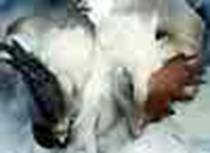
In the above picture the bird on the left has avian influenza. There are further details about the clinical signs in poultry on the Office International des Eepizooties website. Signs in other Birds I have not been able to discover much about the symptoms in other birds. The danger is that other bird species do not seem to be so adversely affected by this virus and can carry it whilst showing few symptoms of disease. If it is brought here by migrating birds the infection will first spread in the wild bird population, these individuals will not necessarily drop dead out of the sky. The Wildfowl and Wetlands Trust, the British Trust for Ornithology and the RSPB are all working with DEFRA to try and identify any abnormal numbers of bird deaths. If you think this is happening you can help by ringing 08459-335577 at anytime and you will be able to talk to a scientist involved with Avian Influenza who will access if further investigations need to be carried out. There are still a large number of unanswered questions about this disease. In the winter in Shropshire we get flocks of Starlings and Redwings from Russia and Woodcock are regular visitors also. It is not clear if they can carry the disease. There are numerous pheasants here and in many ways these behave like free ranging poultry, in all probability I can see no reason why they should be immune to avian influenza. DEFRA have contingency plans and I understand that they have culled two flocks of laying hens in Northern Ireland that were due to be slaughtered to test their methods. During the summer there was an outbreak of New Castle Disease in imported pheasant chicks in Surrey. This was contained on one farm, but one of the problems was identifying where all of the poultry were in the immediate area so that they could be monitored for signs of the disease. Many people keep a few chickens of ducks in their gardens as a hobby. It has been estimated that DEFRA are aware of the whereabouts of only 7% of the poultry flocks. If the disease comes here it is vital that all of the birds are monitored or removed from the immediate area, it is unclear as to how this can be done if no body knows where they are. If you are a small scale poultry keeper like me you will probably realize that it is difficult, if not impossible to keep your birds in for long periods. Birds that are used to free access to your property will not adapt well to confinement. It might well be that when Avian Influenza comes here it will be a problem for some time. At times of high risk you should have some plans to limit the contact your flock has with wild birds. If you have got lots of space you might be able to feed your flock indoors, if not confine them to a small area and see if you can construct a net over their pen to keep visitors out. There is more advise about this and the need for bio security on the following web site. You should be aware that ducks and geese are going to cause us real problems when Avian Influenza comes here as they show few symptoms when they have even the most virulent strain of the virus. It is your chickens that will be affected first. If you start to get unexplained losses please either contact us or ring the DEFRA help line number 08459 335577. If the disease is ever confirmed in Shropshire you will then need to keep your birds indoors so it might be an idea to plan how you might do that now. Living with the Disease The best article I have seen about living with bird flu so far comes from a British Vet who works in France. This will give you some idea as to what it will be like when the disease comes here. The article is a bit long so I have printed it on a separate page. Did you know that there is now a Poultry Register? If at any time of the year you have more than fifty birds on your premises you were obliged to register them before the 28th February 2006. The rules apply to the total number of birds of whatever species so if you have thirty five hens, twelve ducks and six geese you will need to register. The idea of the register is for DEFRA to be able to contact you if the disease situation changes. You can download the application form from the website or phone 08006341112 for more information. Please note the Poultry Register applies to game birds as well so if you rear pheasants or ever have captive birds under your control in release pens you will need to fill in the form. From March last year it has been possible to register smaller numbers of birds on a voluntary basis. I do urge you to do this as I do not see how DEFRA can hope to control this disease when it comes if they do not know where the birds are. Once you have registered DEFRA will send you regular e mails and text messages about the current situation so that you will be able to keep in touch. Let us be sensible about this it is not the same situation as when Foot and Mouth Disease swept through the country six years ago. There is no point in trying to conceal your birds whether they seem healthy or not. This is a serious zoonotic disease and we should treat it as such. The Wider Picture There are two things going on here. If everybody is vigilant it should be possible to contain an outbreak of Avian Influenza in a localized area as most poultry farms have a high standards of bio security and there are few movements of adult birds between farms. It is unlikely that the virus will be here long enough to mutate and get established in people. The real danger is that the infection will cross the species barrier in Asia or China and come here undetected on a passenger plane. Millions of dollars are being spent world wide by different countries to protect themselves against the effects of Bird Flu. The virus has been circulating in Vietnam, Cambodia, Indonesia and China for two years or so now. It is reported that in Indonesia they no longer cull all of the birds within a 5 Km radius of an infected flock, they only have the resources to cull the surviving birds in the affected flock. It seems to me that we should be concentrating our resources in the countries that have the active infection to help them to eradicate the disease rather than snuffing it out as it spreads. In 1997 Hong Kong suffered six human fatalities from the H5N1 strain of the virus. The response was to slaughter all of the 1.5 million chickens in the territory and there were no further human cases. If that is the only way to stop the spread of the virus in a country, then that is what has to be done. When the disease was first found in eight swans in Italy, before it was ever detected in poultry sales of chickens declined dramatically. The Italian farmers confederation said that eight out of ten consumers had stopped buying chicken. The estimate was that in the three months before the virus even arrived in the country the poultry sector had lost £410m and 30,000 workers had been laid off all be it temporarily. Scientists predict that the virulent form of the virus will hit Africa next as that is the winter destination of many of the migratory birds from the areas of the world affected at the moment. We should be concerned about this as many of the birds that visit us in the summer are in Africa at the moment. This is the map of the spread of the virus so far this year although it should be pointed out that in many places it has only occurred in small areas and has only been present for a short time.
|